Quick answer: The best exterior paint for salt air is a system, not a tin: a wash-down that removes the salt, the right primer for each substrate, and two full coats of a 100% acrylic topcoat applied inside the manufacturer’s temperature window. AS 4312 rates Sydney’s surf coast as corrosivity category C5 (very high) within 500 m of the shoreline and C4 (high) from 0.5 km to 1 km, per Table 4.1 of AS 4312-2019 as reproduced by Timber Queensland. That is why the Dulux Weathershield data sheet requires a metal primer on galvanised iron “within 1 km of the sea” instead of self-priming, and why Dulux says to wash coastal exteriors every six months. Most of the coast from Bondi to La Perouse sits inside that 1 km band.
Why does exterior paint fail faster near the beach?
Salt spray settles on every seaward surface. On metal it drives rust: the NATSPEC technote on atmospheric corrosivity puts mild steel loss at 50 to 80 microns a year in C4 and 80 to 200 in C5. On paint, salt holds moisture against the film and lifts any coat applied over it. UV breaks down the binder, giving chalking and fading, worst on north and west elevations. Wind-driven rain and dew find every crack in render and open joint in weatherboard, and dew on an uncured coat can lift it, which is why every sheet below warns against painting when rain or dew is expected.
So a coastal exterior needs better preparation, a primer on anything metal or bare, and a shorter maintenance cycle than the same house in Randwick. See our guide to the benefits of professional exterior painting.
What is the best exterior paint for coastal areas, substrate by substrate?
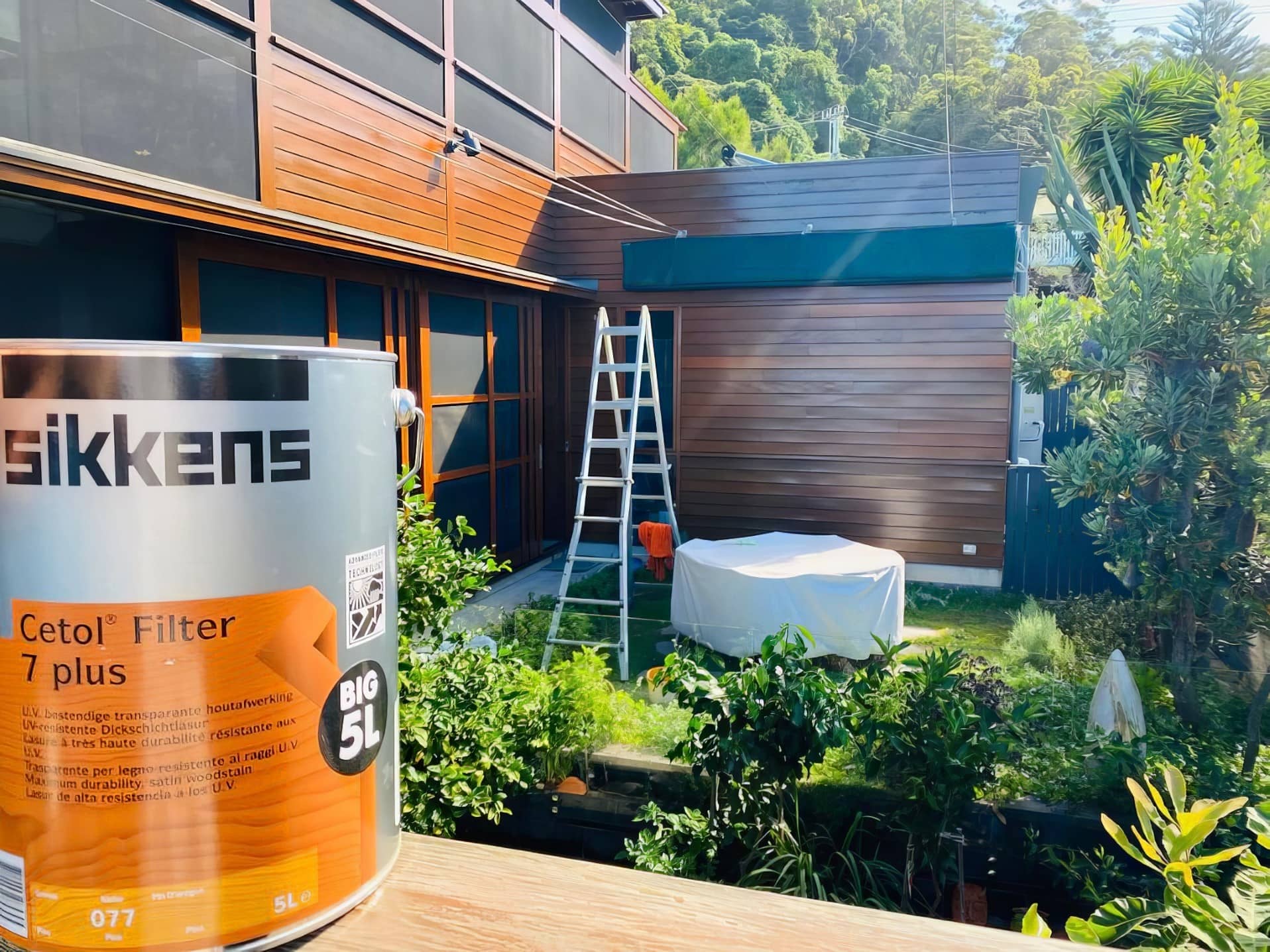
Weatherboard and exterior timber
Greyed timber must be sanded back to sound wood; Taubmans, Haymes and Dulux all say so. Tannin-rich hardwoods (merbau, jarrah, blackbutt, cedar) need a stain-blocking primer such as Dulux 1Step Prep Oil Based or Haymes Ultralock. The Wattyl Solagard data sheet adds that new bare hardwood should weather four to six weeks, rinsed several times, to draw out resin. Then two coats of a flexible 100% acrylic.
Cement render and painted masonry
New render must cure: 28 days per Dulux and Haymes, four to six weeks per Wattyl. On old render the enemy is efflorescence, the white salt bloom that pushes paint off. The Dulux Weathershield Low Sheen page says wipe it with a 5% acetic acid (white vinegar) solution, hose, and let dry. Haymes wants a coat of Ultraseal first; Dulux allows three coats of Weathershield straight onto bare masonry.
Face brick and fibre cement (fibro)
Treated like render on every sheet. Dulux lists “fibro cement” and bricks as Weathershield substrates; Haymes lists both with Ultraseal first. On older fibro, do not sand or blast until you know the sheet is not asbestos cement.
Gutters, downpipes, railings and other metal
- Galvanised iron and Zincalume within 1 km of the sea: the Dulux TDS says “prime with Dulux All Metal Primer”, then two topcoats. Further inland it allows three self-primed coats.
- Weathered galvanised and Colorbond: the Wattyl Killrust system guide says “remove corrosion salts from galvanised iron with a stiff bristle brush or nylon scourer and water”; Solagard and Solashield both require Colorbond “free of salts or other deposits”.
- Rusted steel and wrought iron: wire-brush or sand off all loose rust, then an anti-corrosive primer: two coats of Dulux PRECISION All Metal Primer, Haymes Rustlock, or Wattyl Killrust Heavy Duty Primer (four-hour recoat). Where pitting stops you reaching bright metal, the Killrust guide applies Rust-Eeter rust converter first.
- Aluminium and non-ferrous metal: an etch primer. The Dulux Metalshield Etch Primer sheet (July 2025) is “unaffected by splash and spillage of most salt solutions” but “will chalk on exterior exposure”, so it must be topcoated. Limits: 10 to 40°C, humidity under 85%, surface 3°C above dew point.
Timber windows and doors
Sills and bottom rails fail first because water sits on them. Sand to sound timber, prime bare spots, re-seal open glazing joints, then use the gloss or semi-gloss of the same system. Wattyl’s note for sashes: coat contact areas sparingly and move the windows within 30 minutes and again inside 24 hours.
What do the data sheets say about salt and coastal exposure?
| System | Coastal or salt wording on the sheet | Application limits | Warranty (peel, flake, blister) |
|---|---|---|---|
| Dulux Weathershield Low Sheen (AUDU00073, 2022) | Metal primer on galvanised within 1 km of sea; wash coastal areas every 6 months (product page) | Not below 10°C during drying (consumer page says 5°C); 2 hr recoat | 15 years under DuSpec; lifetime residential |
| Taubmans All Weather Low Sheen | No coastal clause; steel de-rusted and primed; weathered galvanised cleaned; “total UV blockout” | 10 to 35°C; 2 hr recoat | Lifetime for the property owner |
| Haymes Solashield Low Sheen | “Salt resistant: prevents coating degradation”; Colorbond free of salts; steel primed with Rustlock | 10 to 35°C; no rain or dew within 24 hrs | 20 years |
| Wattyl Solagard Low Sheen (D4.14.2, May 2025) | Colorbond and Zincalume free of salts; bare steel must be primed | 5 to 35°C; not in very high humidity or when dew or rain is likely | 25 years |
| Wattyl Killrust Heavy Duty Primer (D2.11, 2021) | Anti-corrosive for steel, wrought iron and galvanised, “even in the harshest of environments” when topcoated | 4 hr recoat | Not stated |
| Dulux Metalshield Etch Primer (LI 009, 2025) | Unaffected by salt splash; must be topcoated | 10 to 40°C; RH max 85% | Not stated |
Note that these warranties cover peeling, flaking and blistering only, not fading or chalking, so a 25-year warranty is not a 25-year repaint interval. And a self-priming paint stops being self-priming the moment the sheet says “within 1 km of the sea”.
What preparation matters most on a coastal exterior?
- Wash the salt off, then let it dry. Fresh-water pressure wash or detergent scrub and rinse. Salt under a new coat will lift it.
- Test the old paint. Cut an X, press tape over it, rip it off. If paint comes away, strip that area (Dulux, Haymes and Wattyl all describe this).
- Treat mould and efflorescence. Bleach for mould; 5% acetic acid for salts on masonry.
- Get to sound timber and sound metal. Sand greyed timber back; wire-brush rust back; converter only where bright metal is unreachable.
- Prime by substrate. Stain-blocker on tannin timbers, anti-corrosive primer on steel, etch primer on aluminium, metal primer on galvanised within 1 km of the water.
- Two full topcoats at the specified build. Weathershield, Solashield and Solagard all specify about 63 microns wet per coat and roughly 16 m² per litre.
Want a written quote for a coastal exterior repaint with the prep and paint system spelled out? Call Trent on 0425 116 817 or use the contact form. You deal with Trent from the quote to the final walk-through.
How often should you repaint a house in Sydney?
No one publishes a coastal-specific number, so here are the figures that exist and their sources.
| Substrate | Typical repaint interval | Source |
|---|---|---|
| Weatherboard and timber | 5 to 7 years | The Paint Crew, Melbourne |
| Cement render | 7 to 10 years | The Paint Crew |
| Painted brick | 10 to 15 years | The Paint Crew |
| Metal cladding and gutters | 10 to 15 years; “salty air may cause faster deterioration” | The Paint Crew |
| Fibre cement | No published figure; grouped with render | Dulux and Haymes sheets above |
| Any substrate, premium system, professionally applied | 8 to 15 years; coastal and exposed walls inspected every 3 to 4 years | Priority One Coatings, Sydney |
Inside the 1 km band, plan for the low end of each range, check the exposed elevations every couple of years, and wash down twice a year. Spot repairs on the weather side cost far less than a repaint brought forward three years.
When is the best time of year to paint an exterior in Sydney?
Match the paint’s limits to Bureau of Meteorology long-term averages for Sydney (Observatory Hill).
- Spring (September to November) is the sweet spot. September is the driest month (68.1 mm, 7.1 rain days), 9am humidity bottoms out in September and October (62% and 61%), and mean maximums of 20 to 24°C suit every sheet.
- February to June is the wettest stretch: every month averages over 117 mm, March the wettest at 131.6 mm and 9.9 rain days. Dry weeks are fine, but the 24-hour no-rain, no-dew rule bites.
- Winter works on clear days, but July’s mean minimum is 8.1°C. Dulux, Taubmans and Haymes all say do not apply if the temperature will drop below 10°C during drying, so coats go on late morning and stop early. Solagard’s 5°C minimum gives more margin.
- High summer means hot surfaces. The Dulux sheet says paint the shady side and, in hot windy conditions, hose the surface cool first. January’s mean maximum is 26°C; a dark north wall runs far hotter.
What this means in the Eastern Suburbs
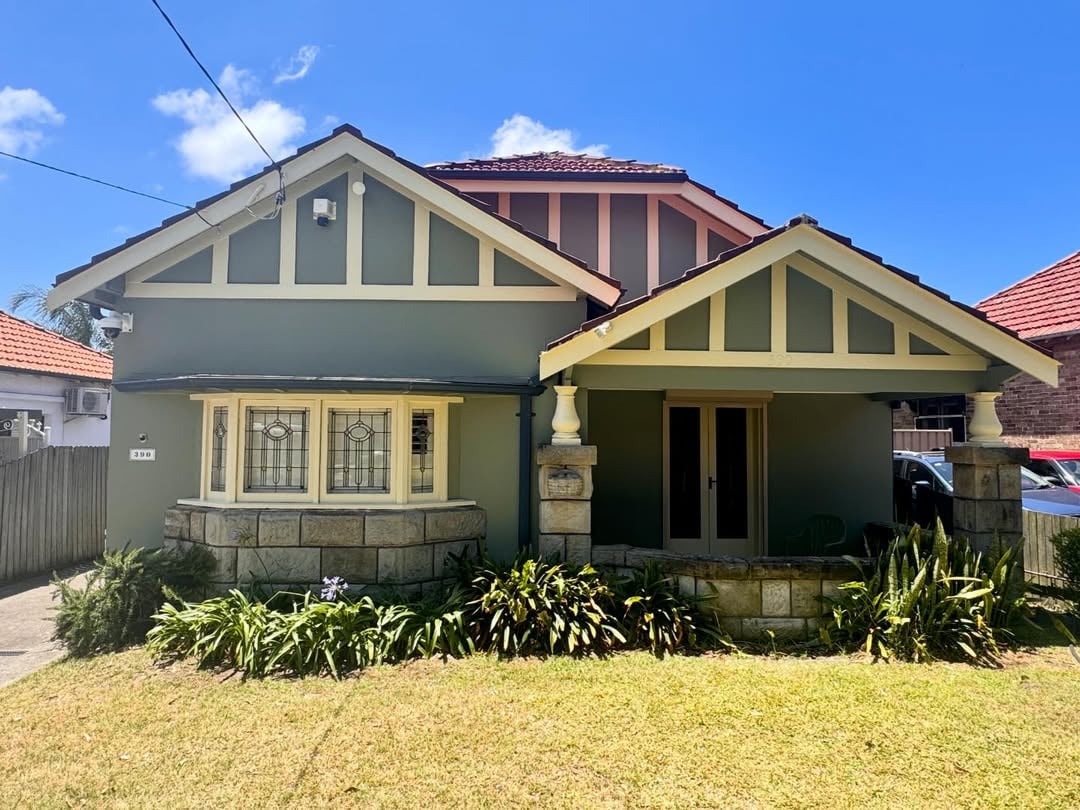
From Bondi, Tamarama and Bronte down through Clovelly, Coogee, Maroubra, Malabar, Little Bay and La Perouse, most streets sit inside the 1 km line and much of the stock is old: Federation weatherboard and brick, interwar rendered bungalows, Art Deco unit blocks with steel windows and render parapets. That means tannin-rich hardwoods, cracked render holding salt, and galvanised gutters self-primed for decades. The same house in Randwick or Kensington gets a longer cycle for the same money.
In practice we specify a metal primer on every coastal gutter, downpipe and railing regardless of what the topcoat says, and we wash before we sand. See our exterior painters in Bondi, house painters in Coogee and Maroubra painting pages, and our residential painting service for the full exterior scope, including strata blocks facing the water.
Frequently asked questions
Is one brand of exterior paint clearly better for salt air?
Not on the data sheets. Weathershield, All Weather, Solashield and Solagard are all 100% acrylic, self-priming on most surfaces and warranted against peeling, flaking and blistering. Haymes alone prints “salt resistant”; Dulux alone prints a 1 km rule for galvanised metal. Preparation and priming matter more than the label.
Do I need a primer if the paint is self-priming?
On sound, previously painted render or timber, usually not. On galvanised metal within 1 km of the sea, the Dulux sheet says yes. On rusted steel and on tannin-rich hardwoods, every sheet says yes. Self-priming describes the best case, not a coastal exterior.
Can you paint an exterior in winter in Sydney?
Yes, on dry days, with care. Sydney’s mean July minimum is 8.1°C at Observatory Hill, and most premium exterior acrylics require the temperature to stay above 10°C through drying, so coats go on late morning and stop mid-afternoon. Wattyl Solagard is rated to 5°C.
Does a 20 or 25 year paint warranty mean no repaint for 20 years?
No. The Haymes 20-year and Wattyl 25-year warranties, and the Dulux and Taubmans lifetime guarantees, cover peeling, flaking and blistering caused by the paint when applied as directed. Fading and chalking are excluded and maintenance conditions still apply. Expect to repaint for appearance well before the warranty ends.